Why National and International Debt Isn’t Just a Bigger Credit Card
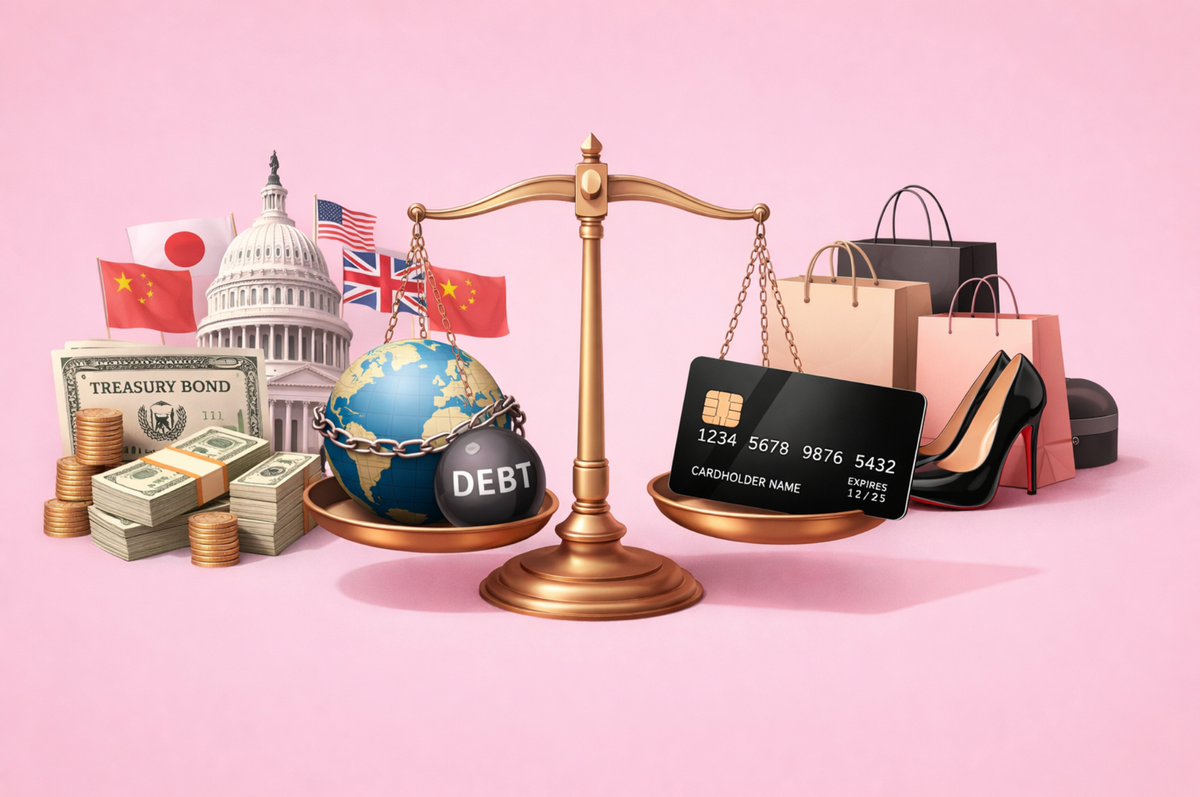
Think about debt in a simple way. Let’s say you earn $60,000 a year after taxes, giving you $5,000 a month. Some months this is enough, some it isn’t, so ideally you might try and carry forward a surplus from, say, March to boost your income in April or June for this example that I am about to give. Perhaps you know you are going on vacation to Saint-Tropez, sipping rosé on a yachting day into a boujee sunset vibe in June, so you might economize in March. Think of March as a period of austerity. Of course, people are not very good at imposing austerity on themselves as we get used to living to the limit of our income, so it is often more likely we go into debt to help finance that Saint-Tropez flex in June.
Imagine that debt plays out in one of two scenarios. Firstly, a 20 year old daughter might ask her father to “lend” her the money for the flights or the hotel, in which the debt is owed within the family. Dad is probably not going to expect this debt to be paid back in set monthly installments in most families, and it is probably likely that most or all of it will not actually be paid off. Eventually, Dad will probably write off this debt and just move on. Think of this as internal debt-borrowing money from within the family.
The alternative is you go to the bank and get a loan, or max out your credit card, in which case monthly installments have to be repaid and interest is charged—it has to be repaid. If you fail to repay regularly or only pay the minimum, then the interest over a long period can end up more than you borrowed, and if you fail to pay (known as defaulting) you get sued. There was a time when a fair percentage of prison inmates were incarcerated for failing to repay debts. Read Great Expectations by Charles Dickens and understand how Pip’s irresponsibility with money ended up with him in Newgate prison as a debtor. Consider this kind of debt, "external", from outside the family.
Anyway, back to the present in which everyone is in some way a debtor. People have mortgages, car loans, credit card bills, or owe money to their parents, siblings or friends. We need to borrow because our income is not enough for our needs. It is impossible to buy a $300,000 apartment with savings from a $5,000 a month income so we spread the payments out over 30 years and pay it off in the future—but we lose our home if we default. Our parents pay all our education fees and bills so technically we have a debt to them, but do we pay this back—probably not. However, when our parents are old and need care, we, as millionaires in the future, might pay their hospital bills or look after many of their financial needs, so this is a kind of delayed repayment of our debt, a kind of deferred payment, and in life many debts are paid off many years after the fact.
Let’s scale this up to a more national or even international level. Most governments acquire their income from taxes, and this is spent running the country or investing in its infrastructure or technological development, or paying social security. The usual case, however, is that most governments do not have enough in taxes to do the things that are planned, so extra income must be raised. If a government doesn't spend enough, the people don’t like it, and if the government demands too much in taxes, the people, again, don’t like it: this is the dilemma. While a government cannot ask “Dad” for a bit of help, it has other methods. It can borrow from its banking system, sell bonds (think of these like IOUs that work like “you buy lunch now, I’ll pay you back with interest later” receipts that countries sell to investors because they need cash today), sell other securities to individuals and institutions, or borrow from foreign countries. As all this money is borrowed, at some point it has to be repaid, with interest of course, just like the banks have to pay you back at some point. The difference is, the amounts are much larger—and the interest rates are better.
In the case of the US, when we talk about a $37 trillion national debt, most of that is to US financial institutions, and individuals—so it is internal and does not have to be paid back “tomorrow” or even this year, and the repayments are staggered over a long period: they can be managed. In fact, if the government has a large amount of capital to repay, it usually issues more debt instruments such as treasury bills, notes, long-term bonds, or other government-backed securities to raise the funds needed to pay off existing obligations. Households, pension funds, mutual funds, banks, and even Social Security trust funds hold big chunks of it (according to the US Treasury and the Congressional Budget Office). About 23–31% of publicly held US debt is held by foreign entities (including governments and private investors), while the rest is held domestically (US Treasury International Capital data, summarized by Pew Research Center). Japan, the UK, and China are among the largest foreign holders of America’s Treasury bonds (US Treasury, December 2024 data).
This is a little bit like Dad always saying to his daughter that he wants his thousand dollars back someday but never really forces the issue. Only around $8 trillion (23%ish of publicly held debt) of the US debt is actually to other countries—Japan holds about $1.1 trillion and the UK about $0.7 trillion—and these countries though are not actually demanding their money back right now because the US also lends or invests money back into their economies in other ways (according to the US Treasury and Pew Research Center).
There is an idea that if you borrow $10,000 from the bank, it is your problem, but if you borrow $200 million, it is the bank’s, and most developed nations try to balance what they owe with what they are owed. This gives them some leverage if they are put under pressure to repay (a point frequently noted in IMF and World Bank sovereign debt analysis). If we look at the UK, while the US owes it $750 billion dollars, the UK’s international debt to other nations is around $800 billion or a quarter of its total. But rich countries have organized and stable economies so they can manage this.
The problems are when the poorer countries have to go into debt, and in order to build an airport or a highway, foreign loans have to be acquired and over 20 years or more interest has to be paid—so they often default. It is common to just write off these loans after a time as it is more trouble than it is worth to pursue repayments (World Bank and IMF debt relief programs, including HIPC initiatives). Besides that, by being overly demanding on a poor country to pay off its loans, its people suffer and end up migrating—possibly to your country and becoming your problem. Economic migrants have often ended up in the US and sometimes it would have been better to have just been softer on their countries regarding loan repayments in order to help them stay there.
On a more recognizable scale, imagine instead that your Dad or husband buys you your dream car (say an G-Wagon or a Porsche 911) and quietly writes it off. There is no repayment schedule, no interest, and no real consequence if you never pay it back. But if you try to buy that same car yourself while you’re operating on ambition rather than balance sheet strength, the bank is not going to be nearly as generous. The loan has to be repaid, with interest, and if you fail to pay, there are consequences. This is the same difference that exists between forgiving debt and enforceable debt—and it explains why debt is survivable for rich countries but often devastating for poorer ones.
The main difference between countries and individuals is that while much of a developed country’s debt is internal, most of an individual’s debt is external. And while we seem to concern ourselves with the fact that a 124% debt-to-GDP ratio for a $27–30 trillion GDP country looks scary (according to the U.S. Department of Treasury), we should not forget that many individuals earning $100,000 a year carry debts several times more than that, including mortgages, student loans, auto loans and credit card debt (Federal Reserve Survey of Consumer Finances). France offers a reminder of the limits of this logic: with public debt rising toward 113–115% of GDP in 2025, weak growth, persistent deficits, and higher borrowing costs, markets and rating agencies have begun questioning fiscal credibility—showing that debt is manageable, but not without consequences. So the next time debt numbers make headlines, think less about the size and more about who’s footing the bill. Just like that Saint-Tropez trip, borrowing works until someone starts asking when you’re paying it back—and France is learning what happens when the vibe shifts.